

Trig Form Of Complex Numbers
five.ii: The Trigonometric Form of a Complex Number
- Page ID
- 7125

Focus Questions
The post-obit questions are meant to guide our study of the material in this section. After studying this section, we should empathise the concepts motivated by these questions and be able to write precise, coherent answers to these questions.
- What is the polar (trigonometric) form of a complex number?
- How exercise we multiply two complex numbers in polar form?
- How do we separate ane complex number in polar course by a nonzero complex number in polar form?
Kickoff Activity
If \(z = a + bi\) is a complex number, and so we can plot \(z\) in the plane as shown in Effigy \(\PageIndex{ane}\). In this situation, we will let \(r\) be the magnitude of \(z\) (that is, the distance from \(z\) to the origin) and \(\theta\) the angle \(z\) makes with the positive existent centrality equally shown in Figure \(\PageIndex{1}\).
Use right triangle trigonometry to write \(a\) and \(b\) in terms of \(r\) and \(\theta\).
Explain why nosotros tin can write \(z\) as
\[z = r(\cos(\theta) + i\sin(\theta)). \]
When we write \(z\) in the course given in Equation \(\PageIndex{1}\):, we say that \(z\) is written in trigonometric form (or polar form).
The angle \(\theta\) is called the argument of the argument of the complex number \(z\) and the real number \(r\) is the modulus or norm of \(z\). To find the polar representation of a complex number \(z = a + bi\), nosotros first observe that
\[r = |z| = \sqrt{a^{2} + b^{2}}\]
\[a = r\cos(\theta)\]
\[b = r\sin(\theta)\]
Multiplication of complex numbers is more complicated than improver of complex numbers. To better understand the product of complex numbers, nosotros commencement investigate the trigonometric (or polar) course of a complex number. This trigonometric form connects algebra to trigonometry and volition be useful for quickly and easily finding powers and roots of complex numbers.
Note
The word polar hither comes from the fact that this procedure can exist viewed as occurring with polar coordinates.
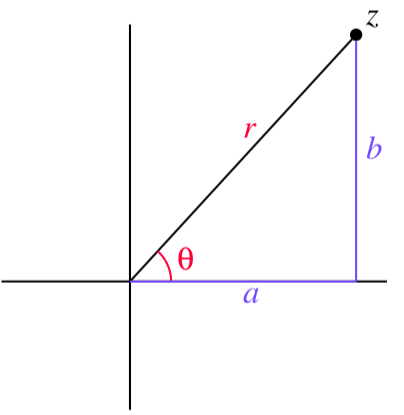
Figure \(\PageIndex{1}\): Trigonometric class of a complex number.
To find \(\theta\), we have to consider cases.
- If \(z = 0 = 0 + 0i\),so \(r = 0\) and \(\theta\) can have whatever real value.
- If \(z \neq 0\) and \(a \neq 0\), then \(\tan(\theta) = \dfrac{b}{a}\).
- If \(z \neq 0\) and \(a = 0\) (so \(b \neq 0\)), and so
\[^* \space \theta = \dfrac{\pi}{two} \space if \space b > 0\]
\[^* \space \theta = -\dfrac{\pi}{two} \space if \infinite b < 0\]
Do \(\PageIndex{1}\)
- Make up one's mind the polar course of the circuitous numbers \(w = 4 + four\sqrt{3}i\) and \(z = 1 - i\).
- Determine existent numbers \(a\) and \(b\) so that \(a + bi = three(\cos(\dfrac{\pi}{6}) + i\sin(\dfrac{\pi}{half dozen}))\)
- Reply
-
1. Note that \(|w| = \sqrt{4^{2} + (four\sqrt{3})^{2}} = 4\sqrt{four} = 8\) and the statement of \(westward\) is \(\arctan(\dfrac{4\sqrt{3}}{4}) = \arctan\sqrt{iii} = \dfrac{\pi}{3}\). So
\[w = 8(\cos(\dfrac{\pi}{3}) + \sin(\dfrac{\pi}{iii}))\]
Also, \(|z| = \sqrt{i^{ii} + 1^{ii}} = \sqrt{two}\) and the argument of \(z\) is \(\arctan(\dfrac{-ane}{1}) = -\dfrac{\pi}{4}\).
So \[z = \sqrt{2}(\cos(-\dfrac{\pi}{4}) + \sin(-\dfrac{\pi}{4})) = \sqrt{two}(\cos(\dfrac{\pi}{iv}) - \sin(\dfrac{\pi}{four})\]
2. Recall that \(\cos(\dfrac{\pi}{half-dozen}) = \dfrac{\sqrt{3}}{2}\) and \(\sin(\dfrac{\pi}{6}) = \dfrac{1}{2}\). Then \[3(\cos(\dfrac{\pi}{6} + i\sin(\dfrac{\pi}{half dozen})) = 3(\dfrac{\sqrt{3}}{two} + \dfrac{one}{2}i) = \dfrac{3\sqrt{3}}{two} + \dfrac{3}{two}i\]
So \(a = \dfrac{3\sqrt{3}}{two}\) and \(b = \dfrac{three}{two}\).
There is an alternate representation that you will oftentimes see for the polar grade of a complex number using a complex exponential. Nosotros won't go into the details, but just consider this equally notation. When nosotros write \(e^{i\theta}\) (where \(i\) is the complex number with \(i^{2} = -1\)) we hateful
\[e^{i\theta} = \cos(\theta) + i\sin(\theta)\]
So the polar form \(r(\cos(\theta) + i\sin(\theta))\) can also exist written every bit \(re^{i\theta}\):
\[re^{i\theta} = r(\cos(\theta) + i\sin(\theta))\]
Products of Complex Numbers in Polar Grade
In that location is an important product formula for circuitous numbers that the polar form provides. We illustrate with an example.
Example \(\PageIndex{1}\): Products of Complex Numbers in Polar Grade
Permit \(west = -\dfrac{1}{2} + \dfrac{\sqrt{3}}{2}i\) and \(z = \sqrt{3} + i\). Using our definition of the product of complex numbers nosotros see that
\[wz = (\sqrt{3} + i)(-\dfrac{one}{two} + \dfrac{\sqrt{3}}{two}i) = -\sqrt{3} + i.\]
At present we write \(w\) and \(z\) in polar course. Annotation that \(|w| = \sqrt{(-\dfrac{one}{2})^{2} + (\dfrac{\sqrt{three}}{ii})^{two}} = 1\) and the argument of \(w\) satisfies \(\tan(\theta) = -\sqrt{3}\). Since \(w\) is in the 2nd quadrant, we meet that \(\theta = \dfrac{two\pi}{3}\), so the polar course of \(west\) is \[w = \cos(\dfrac{2\pi}{3}) + i\sin(\dfrac{2\pi}{3})\]
Also, \(|z| = \sqrt{(\sqrt{iii})^{2} + one^{2}} = ii\) and the argument of \(z\) satisfies \(\tan(\theta) = \dfrac{one}{\sqrt{3}}\).
Since \(z\) is in the first quadrant, we know that \(\theta = \dfrac{\pi}{6}\) and the polar form of \(z\) is \[z = 2[\cos(\dfrac{\pi}{6}) + i\sin(\dfrac{\pi}{half-dozen})]\]
We can as well find the polar class of the circuitous product \(wz\). Here we accept \(|wz| = two\), and the argument of \(zw\) satisfies \(\tan(\theta) = -\dfrac{1}{\sqrt{3}}\). Since \(wz\) is in quadrant II, nosotros see that \(\theta = \dfrac{five\pi}{6}\) and the polar grade of \(wz\) is \[wz = 2[\cos(\dfrac{5\pi}{6}) + i\sin(\dfrac{five\pi}{6})].\]
When we compare the polar forms of \(w, z\), and \(wz\) nosotros might notice that \(|wz| = |due west||z|\) and that the argument of \(zw\) is \(\dfrac{2\pi}{three} + \dfrac{\pi}{6}\) or the sum of the arguments of \(w\) and \(z\). This turns out to exist true in general.
The consequence of Example \(\PageIndex{1}\) is no coincidence, equally we will testify. In general, nosotros have the following important result about the production of 2 circuitous numbers.
Multiplication of Complex Numbers in Polar Class
Allow \(west = r(\cos(\blastoff) + i\sin(\alpha))\) and \(z = south(\cos(\beta) + i\sin(\beta))\) be complex numbers in polar course. Then the polar form of the complex product \(wz\) is given by
\[wz = rs(\cos(\alpha + \beta) + i\sin(\blastoff + \beta))\]
This states that to multiply ii circuitous numbers in polar form, we multiply their norms and add together their arguments.
To sympathise why this consequence information technology true in general, let \(west = r(\cos(\alpha) + i\sin(\alpha))\) and \(z = south(\cos(\beta) + i\sin(\beta))\) be circuitous numbers in polar grade. We will utilize cosine and sine of sums of angles identities to discover \(wz\):
\[w = [r(\cos(\alpha) + i\sin(\alpha))][due south(\cos(\beta) + i\sin(\beta))] = rs([\cos(\alpha)\cos(\beta) - \sin(\alpha)\sin(\beta)]) + i[\cos(\alpha)\sin(\beta) + \cos(\beta)\sin(\alpha)]\]
Nosotros now utilize the cosine and sum identities and see that
\(\cos(\alpha + \beta) = \cos(\alpha)\cos(\beta) - \sin(\alpha)\sin(\beta)\) and \(\sin(\alpha + \beta) = \cos(\blastoff)\sin(\beta) + \cos(\beta)\sin(\alpha)\).
Using equation (ane) and these identities, nosotros come across that
\[w = rs([\cos(\blastoff)\cos(\beta) - \sin(\alpha)\sin(\beta)]) + i[\cos(\alpha)\sin(\beta) + \cos(\beta)\sin(\alpha)] = rs(\cos(\alpha + \beta) + i\sin(\alpha + \beta))\]
An illustration of this is given in Figure \(\PageIndex{ii}\). The formula for multiplying complex numbers in polar form tells the states that to multiply two complex numbers, we add their arguments and multiply their norms.
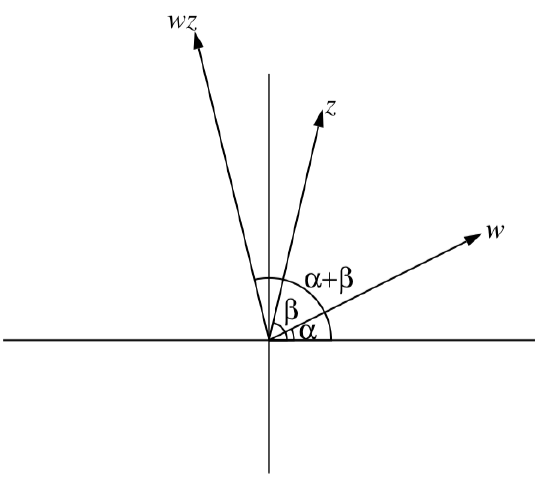
Figure \(\PageIndex{2}\): A Geometric Estimation of Multiplication of Complex Numbers.
Exercise \(\PageIndex{2}\)
Allow \(w = 3[\cos(\dfrac{5\pi}{3}) + i\sin(\dfrac{5\pi}{3})]\) and \(z = 2[\cos(-\dfrac{\pi}{4}) + i\sin(-\dfrac{\pi}{four})]\).
- What is \(|wz|\)?
- What is the argument of \(wz\)?
- In which quadrant is \(wz\)? Explicate.
- Determine the polar form of wz.
- Describe a film of \(w\), \(z\), and \(wz\) that illustrates the action of the complex product.
- Answer
-
1. Since \(|due west| = 3\) and \(|z| = 2\), we run across that
\[|wz| = |west||z| = (iii)(2) = 6\]
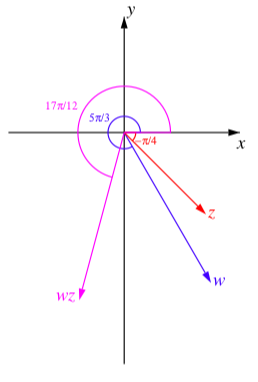
2. The argument of \(w\) is \(\dfrac{5\pi}{three}\) and the statement of \(z\) is \(-\dfrac{\pi}{4}\), nosotros see that the argument of \(wz\) is \[\dfrac{five\pi}{three} - \dfrac{\pi}{iv} = \dfrac{20\pi - 3\pi}{12} = \dfrac{17\pi}{12}\]
3. The terminal side of an angle of \(\dfrac{17\pi}{12} = \pi + \dfrac{5\pi}{12}\) radians is in the third quadrant.
4. We know the magnitude and statement of \(wz\), then the polar form of \(wz\) is
\[wz = vi[\cos(\dfrac{17\pi}{12}) + \sin(\dfrac{17\pi}{12})]\]
5. Following is a flick of \(w, z\), and \(wz\) that illustrates the action of the complex product.
Quotients of Complex Numbers in Polar Class
We have seen that we multiply complex numbers in polar form by multiplying their norms and adding their arguments. There is a similar method to divide one complex number in polar course past another complex number in polar grade.
Division of Complex Numbers in Polar Form
Let \(w = r(\cos(\alpha) + i\sin(\blastoff))\) and \(z = s(\cos(\beta) + i\sin(\beta))\) be complex numbers in polar form with \(z \neq 0\). And then the polar form of the complex quotient \(\dfrac{w}{z}\) is given by \[\dfrac{west}{z} = \dfrac{r}{due south}(\cos(\alpha - \beta) + i\sin(\alpha - \beta)).\]
So to dissever complex numbers in polar class, we divide the norm of the complex number in the numerator past the norm of the complex number in the denominator and decrease the argument of the complex number in the denominator from the statement of the circuitous number in the numerator.
The proof of this is like to the proof for multiplying complex numbers and is included as a supplement to this department.
Exercise \(\PageIndex{3}\)
Let \(w = three[\cos(\dfrac{5\pi}{3}) + i\sin(\dfrac{5\pi}{3})]\) and \(z = two[\cos(-\dfrac{\pi}{iv}) + i\sin(-\dfrac{\pi}{4})]\).
- What is \(|\dfrac{w}{z}|\)?
- What is the argument of \(|\dfrac{w}{z}|\)?
- In which quadrant is \(|\dfrac{west}{z}|\)? Explain.
- Determine the polar grade of \(|\dfrac{w}{z}|\).
- Describe a picture of \(due west\), \(z\), and \(|\dfrac{w}{z}|\) that illustrates the action of the complex production.
- Respond
-
1. Since \(|w| = iii\) and \(|z| = 2\), we see that
\[|\dfrac{w}{z}| = \dfrac{|w|}{|z|} = \dfrac{3}{2}\]
2. The statement of \(w\) is \(\dfrac{5\pi}{three}\) and the statement of \(z\) is \(-\dfrac{\pi}{4}\), we see that the argument of \(\dfrac{due west}{z}\) is
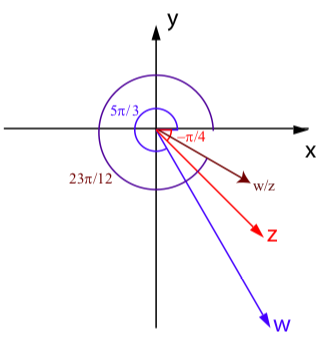
\[\dfrac{5\pi}{3} - (-\dfrac{\pi}{4}) = \dfrac{20\pi + three\pi}{12} = \dfrac{23\pi}{12}\]
3. The concluding side of an angle of \(\dfrac{23\pi}{12} = 2\pi - \dfrac{\pi}{12}\) radians is in the 4th quadrant.
4. We know the magnitude and argument of \(wz\), so the polar form of \(wz\) is \[\dfrac{due west}{z} = \dfrac{three}{2}[\cos(\dfrac{23\pi}{12}) + \sin(\dfrac{23\pi}{12})]\]
five. Post-obit is a picture of \(westward, z\), and \(wz\) that illustrates the activity of the circuitous product.
Proof of the Rule for Dividing Complex Numbers in Polar Form
Permit \(w = r(\cos(\alpha) + i\sin(\alpha))\) and \(z = s(\cos(\beta) + i\sin(\beta))\) be complex numbers in polar course with \(z \neq 0\). And then
\[\dfrac{w}{z} = \dfrac{r(\cos(\alpha) + i\sin(\alpha))}{s(\cos(\beta) + i\sin(\beta)} = \dfrac{r}{s}\left [\dfrac{\cos(\alpha) + i\sin(\blastoff)}{\cos(\beta) + i\sin(\beta)} \right ]\]
We will piece of work with the fraction \(\dfrac{\cos(\blastoff) + i\sin(\alpha)}{\cos(\beta) + i\sin(\beta)}\) and follow the usual practice of multiplying the numerator and denominator by \(\cos(\beta) - i\sin(\beta)\). Then
\[\dfrac{westward}{z} = \dfrac{r}{southward}\left [\dfrac{(\cos(\alpha) + i\sin(\alpha))}{(\cos(\beta) + i\sin(\beta)} \right ] = \dfrac{r}{s}\left [\dfrac{(\cos(\alpha) + i\sin(\alpha))}{(\cos(\beta) + i\sin(\beta)} \cdot \dfrac{(\cos(\beta) - i\sin(\beta))}{(\cos(\beta) - i\sin(\beta)} \correct ] = \dfrac{r}{s}\left [\dfrac{(\cos(\alpha)\cos(\beta) + \sin(\alpha)\sin(\beta)) + i(\sin(\alpha)\cos(\beta) - \cos(\alpha)\sin(\beta)}{\cos^{2}(\beta) + \sin^{2}(\beta)} \right ]\]
We now apply the following identities with the last equation:
- \(\cos(\alpha)\cos(\beta) + \sin(\alpha)\sin(\beta) = \cos(\alpha - \beta)\)
- \(\sin(\alpha)\cos(\beta) - \cos(\blastoff)\sin(\beta) = \sin(\alpha - \beta)\)
- \(\cos^{2}(\beta) + \sin^{ii}(\beta) = i\)
Using these identities with the last equation for \(\dfrac{west}{z}\), we encounter that
\[\dfrac{w}{z} = \dfrac{r}{s}[\dfrac{\cos(\alpha - \beta) + i\sin(\alpha- \beta)}{ane}].\]
Summary
In this department, nosotros studied the following important concepts and ideas:
If \(z = a + bi\) is a complex number, and then we can plot \(z\) in the airplane. If \(r\) is the magnitude of \(z\) (that is, the distance from \(z\) to the origin) and \(\theta\) the angle \(z\) makes with the positive existent axis, and then the trigonometric form (or polar form) of \(z\) is \(z = r(\cos(\theta) + i\sin(\theta))\), where
\[r = \sqrt{a^{ii} + b^{2}}, \cos(\theta) = \dfrac{a}{r}\]
and \[\sin(\theta) = \dfrac{b}{r}\]
The angle \(\theta\) is called the argument of the circuitous number \(z\) and the real number \(r\) is the modulus or norm of \(z\).
If \(w = r(\cos(\blastoff) + i\sin(\alpha))\) and \(z = s(\cos(\beta) + i\sin(\beta))\) are complex numbers in polar form, so the polar form of the complex product \(wz\) is given past
\[wz = rs(\cos(\blastoff + \beta) + i\sin(\alpha + \beta))\] and \(z \neq 0\), the polar course of the complex quotient \(\dfrac{w}{z}\) is
\[\dfrac{due west}{z} = \dfrac{r}{s}(\cos(\blastoff - \beta) + i\sin(\alpha - \beta)),\]
This states that to multiply two complex numbers in polar form, we multiply their norms and add their arguments, and to divide 2 complex numbers, we divide their norms and decrease their arguments.

Trig Form Of Complex Numbers,
Source: https://math.libretexts.org/Bookshelves/Precalculus/Book%3A_Trigonometry_(Sundstrom_and_Schlicker)/05%3A_Complex_Numbers_and_Polar_Coordinates/5.02%3A_The_Trigonometric_Form_of_a_Complex_Number
Posted by: osbornutall1992.blogspot.com
0 Response to "Trig Form Of Complex Numbers"
Post a Comment