

Formula For Area Of Kite
As a particular office of math science, you can apply geometry in everyday situations. Then this mode, we can mention the case of flying a kite. Yous must have found yourself in a position of looking high into the heaven following the trajectory of a kite. And, at the same time, wondering how you could calculate the area of a kite. Just for you and other curious people, we nowadays you lot CalCon calculator that measures the area of a kite. You tin can read more about the measurement method below.
What Is the Area of a Kite?
We will begin with an caption of the geometric body of a kite. According to Euclidean math and geometry, kites are quadrangular shapes whose sides you can group into two pairs of equal lengths that stand next to each other. They are too known equally deltoid bodies. The word "deltoid" refers to a deltoid bend that is an unrelated geometric object.
When it comes to the kite area, it is presented as the infinite that surrounds the kite. The parts that make upwards the kite are four corners, four sides, and two diagonals. Based on these elements, you lot can decide the formula for calculating the tendon area, which nosotros will explain below. Information technology is also important to mention that you can view the surface area as covered with the kite. Since this shape resembles an elongated square or rhombus, the kite also does not equal all sides.
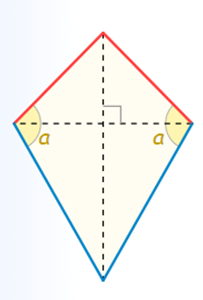
Expanse of kite formula
Y'all have decided to make the kite yourself, and the surface will represent the size of the textile used to brand information technology. If you take pieces of woods, they will convey the kite'southward diagonals that will back up and tighten the fabric around the pieces of wood, forming the appearance of a kite. Given the above, the calculation formula looks like this:
A = \frac{p\cdot q}{two}
where p and q are diagonals.
When it comes to calculating using our calculator, we distinguish two situations. Our calculator offers the power to calculate the area of a kite if you lot know the values of both diagonals or the values of contrary sides and the angle they shut.
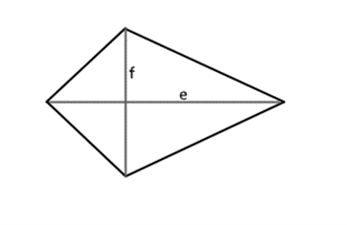
If y'all know the diagonal values, then it is enough to enter the data in the predicted places marked with the letters e and f. The adding formula looks like this:
A = \frac{eastward\cdot f}{2}
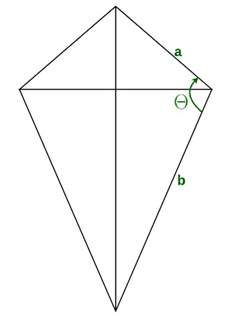
When you know the values of the lengths of two non-congruent pages, and the angles betwixt those pages marked a and b, so you demand to apply the following formula:
A = a\cdot b\cdot sin\alpha
Kite perimeter
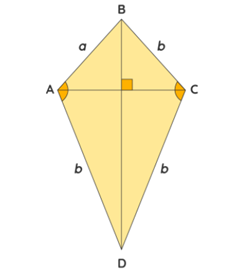
It is necessary to accept the values of each pair of unequal sides a and b for calculating the perimeter of a kite. The sum of all the sides of a kite represents the perimeter of a kite. Therefore, the formula for computing the perimeter has the following advent:
Perimeter = a+b+a+b = ii\cdot (a+b)
Kite Area & Perimeter – work with steps
Example one:
We will give the start example to summate the perimeter of a kite:
Side a of a kite has a length of 11 inches, while side b has a length of 17 inches.
It is necessary to find the perimeter of a kite.
P = 2\cdot (a+b) = 2\cdot \left ( 11+17 \correct ) = two\cdot 28 = 56inch
In this case, the perimeter of a kite has a value of 56 inches.
Example 2:
We volition consider the situation that you want to give your closest friend a chocolate bar in a box in a kite shape. You lot desire to decorate the package to paste a photo of y'all and your friend on superlative. Showtime, yous must make up one's mind the surface area of the box cover if the diagonal values are in the following amounts of 10 inches and 15 inches, respectively.
Y'all tin utilise the formula:
A = \frac{e\cdot f}{2} = \frac{10\cdot fifteen}{two} = 75inch^{2}
How to observe the diagonals of a kite?
As a unique geometric shape, the kite contains ii diagonals whose lengths are different. They intersect as such, making a correct bending. In the following example, y'all volition learn how to calculate the value of the diagonal length having the value of the surface area of a kite.
Instance:
It is known that the value of the full area of a kite is 144inch2 and that the value of one diagonal is twice as long as the value of the other. Find the length of each diagonal.
Solution:
As you take previously become acquainted with the formula for calculating the area, with minor changes in the appearance of the formula, you can calculate the values of the diagonals. With the information given at the beginning that ane diagonal is twice as long every bit the other, the formula has the post-obit appearance:
A = \frac{a\cdot b}{2}
a : b = one : 2
a = 2b
For ease of further calculation, we will assume that diagonal a denote past ten and diagonal b by 2x.
144 = \frac{x\cdot 2x}{2} \Rightarrow 288 = two\cdot ten^{2} \Rightarrow x^{2} = 144 \Rightarrow x = 12inch
Later on calculating the x, diagonal a has a value of 12 inches, while the value of diagonal b is 24 inches.
Convex and concave kites
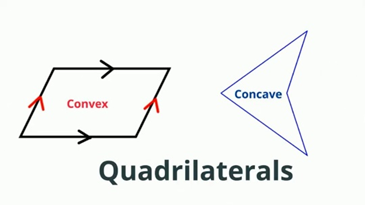
Kites can virtually ofttimes be found in a convex shape, while less ofttimes in a concave one chosen a "dart" kite. As well, in math, you tin find them as quadrilaterals. Convex types of kites are those whose internal angles accept a value of fewer than 180 degrees. Otherwise, for concave shapes, at to the lowest degree one of the angles has a value greater than 180 degrees. With the procedure of measuring the surface area for these types of kites, the process is the aforementioned in the case of using our figurer and deciding to use the formula.
Properties of kites
Knowing the properties of this geometric shape tin assistance you lot solve problems where y'all know the values of pages and angles. The properties include two consecutive sides, matching non-summit angles, and diagonals of different lengths. In improver to these properties, it is essential to annotation that you should be familiar with the properties of other related geometric bodies such as trapezoids, parallelograms, rhombuses, rectangles, and squares.
Is a kite a rhombus?
The master visible departure between a rhombus and a kite is that in a rhombus, all sides are equal, while in a kite, the situation is the existence of two adjacent equal sides. Therefore, we cannot say that a kite is a rhombus, but the opposite is true where every rhombus is a kite. While with a kite, depending on the shape, length of the pages, the values of the angles may or may not mean that each kite is a rhombus.

Formula For Area Of Kite,
Source: https://calconcalculator.com/math/kite-area-calculator/
Posted by: osbornutall1992.blogspot.com
0 Response to "Formula For Area Of Kite"
Post a Comment